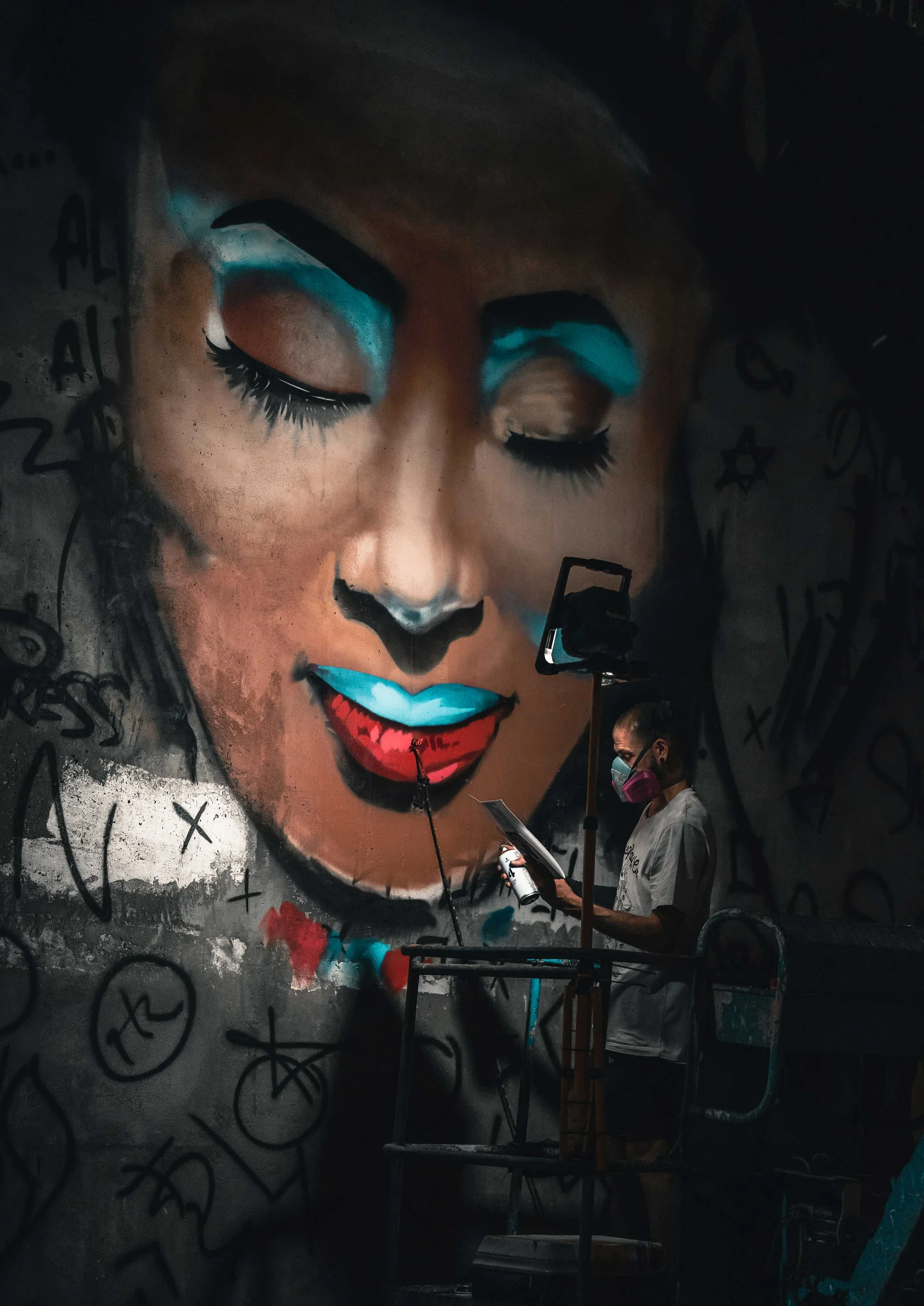
Avi Tal
Israeli muralist. Paints at architectural scale, entirely by hand. Holds the Guinness World Record for the largest spray-paint mural completed by a single artist.
Avi Tal, who works as SPINE B7, is an Israeli muralist. He paints at architectural scale, entirely by hand, and holds the Guinness World Record for the largest spray-paint mural completed by a single artist. He was born in Be'er Sheva on 13 May 1986 and grew up there; he now lives in a small countryside town close to the Mediterranean sea.
Where it comes from
His parents left the Soviet Union in 1974. Getting out took connections and cost them a great deal, and they arrived in Israel with little — not destitute, but with nothing behind them. On their first day in the country, at the absorption centre in Arad, a man offered his father and his father's stepbrother work in construction. They took it that day. His father earned about fifty shekels and could not believe what that money bought.
What the family had instead of money was two very different kinds of skill, and he inherited both.
His father, Valery Tal, was born Valery Skripchenko in Odesa in 1946 and held a second degree in engineering from the Soviet system — a precise, technical man, one of only three people in Israel of his generation licensed to handle explosives for construction work. As a boy he had built model aircraft, boats and radio-controlled machines, and he passed that on. His mother, Katia Tal, was born Katia Lebedenko near Dushanbe in 1944 and raised in Ukraine from a young age; she drew and painted. Avi is the meeting point of the two: the hand and the calculation.
The family name came later, and it came out of a fight. His older brother Ralph took no nonsense at school and returned every provocation with a fair fight, and their father grew tired of being summoned to the principal's office to collect him. Father and son sat down at home with the telephone directory and looked for the shortest, most Israeli name they could find. They found Tal. They went to the Ministry of the Interior together and changed it.
The technical foundation
When he was ten, his father enrolled him at the Aviation Club of Israel, near the family home. He stayed for the better part of a decade. He learned to read technical drawings, work to measurement, design his own plans, and build aircraft that grew steadily larger and more complex. His instructors selected him, out of many, for an enrichment program at the Technion in Haifa — weeks of concentrated study in aerodynamics, structural integrity and physics, applied directly to structures he built himself, alongside training to instruct others.
This is not decorative biography. It is the foundation of how he works. He knows what a surface will do over twenty years of weather, how a structure carries load, what will hold and what will fail. Most artists working at his scale do not have that knowledge, and it is the difference between a picture applied to a building and a work built into one.
Cans, tags, and a courthouse
2002–2005In 2002 he picked up spray cans. Be'er Sheva in those years offered a boy from a poor family very little; he found graffiti and BMX, and through them a culture that made sense to him. His first tag was simply AVI, written in a handwriting deliberately mangled so nobody could read it. He used it three times. Then CHIZ, then KRUSE. In 2005 he became SPINE.
That same early period produced the turn that decided everything. He painted the walls of the main courthouse of Israel's entire southern district. Friends informed on him, and detectives brought him in. He was sentenced to 250 hours of community service.
He went to the principal of Rabin High School and argued that his hours would be worth more spent painting the school's walls than repairing broken chairs. The principal agreed. It was the first time he worked large, legally, with a wall handed to him on purpose — and the first time he understood he had a talent for scale specifically. The record he carries from that arrest is a matter of public fact, and he has never seen a reason to hide it. It is where the work started.
Military service followed, then the years of experiment: styles, surfaces, methods, and how far a wall could be pushed.
The Netherlands
2009–2012He left Israel for the first time on a one-way ticket with 120 euros his father had given him and nothing in the bank, hired by a company selling original oil paintings door to door. He was trained in the pitch and sent out. Within days a new consignment arrived and he opened the crates to sort them: five identical paintings, printed, with brushwork added on top for texture. He asked. He was told the story about art students in China was simply the gig.
He could not knock on a stranger's door and sell that. He let the van drop him in his assigned neighbourhood, walked to the nearest park, laid the bag of paintings on the grass, used it as a mattress and waited out the hours until pickup. He did that until he quit, about ten days in.
He stayed in the country anyway, living in Roosendaal for three years — and those years opened the work. He lived with a practising artist and learned oil and acrylic, having until then known only graffiti and pencil. He saw what art could be beyond a wall and a can, and he learned that it could also pay: ING commissioned a mural from him for a company event, the first time he understood this could be a profession rather than a compulsion.
He enrolled at St. Joost and left after a few months. He had come to sharpen the work; he was told to forget what he knew and learn how to talk about it instead. Having just escaped a job that was nothing but talk wrapped around a fake product, he refused to spend his time learning a better pitch. He went back to painting.
Going professional
2012–2014He returned to Israel in 2012 and turned professional. Inquiries came from some of the largest companies in the country, and the walls grew — up to 600 square metres for a single commission.
In 2014, shortly after returning, he began working with the Neot Hovav Regional Council, painting the industrial landscape of the Negev: factory facades, water tanks, structures at the scale of heavy industry. The work totals well over 2,500 square metres. Some of it faces the council's main road and is visible to everyone who drives it; some sits inside plant grounds closed to the public. At the time nothing on that scale existed in Israel by a single hand.
The record
2016–2020Preparation began months earlier — equipment, permissions, logistics. He started painting the exterior of Dimona's municipal soccer stadium in March 2016 and finished at the end of that year. It took that long because he stopped more than twenty times. Municipalities in Israel pay sixty to ninety days after a project closes, and he had no backing, no family money, nothing behind him. Each time the money ran out he paused the record attempt, took a paying commission, ate, kept the roof, and went back to the wall.
Then came the documentation: witness statements, affidavits, verification, and a licensed surveyor's measurement filmed on video — the single mandatory piece of evidence Guinness would not proceed without.
In early 2017 he lost the hard drive holding that footage. It fell somewhere in the desert without his noticing. There was no backup; the drive was the backup. He searched the house repeatedly, friends' homes, every site he could remember, and posted public appeals across his social accounts for close to a year. Eventually he accepted it was gone, and with it the record — a year of painting and three years of verification.
Months later a message arrived on his business account. Someone asked whether he had lost a hard drive. A hiker had found one lying on a desert trail, passed it to a friend who was more comfortable with computers, and that friend plugged it in, found the work and the files, and traced them back to their owner. The drive was intact. He collected it the same day.
Guinness World Records confirmed the record in early 2020: largest spray-paint mural by a single artist — 2,038.96 m², painted alone, freehand, no projectors, no printed imagery.
He then paid £37 for the certificates. When they arrived he filmed himself opening them and found the imperial conversion wrong — Guinness had multiplied by three instead of converting, printing roughly 6,689 square feet where the true figure is 21,947.18. He reported the error. He was told it was his responsibility for approving the text. The website was corrected; the printed certificates never were. He drew a red X through the figure, wrote the correct measurement beneath it by hand, and hung it in his office that way.
Curation and public space
2016–2021Alongside his own commissions he has curated five street art events and galleries across Israel, bringing other artists into public space: a street art gallery at the Be'er Sheva Youth Center in 2016, a rotating mural program at Pub 40 through 2017, and others. In 2019 he covered the four-storey facade of the POP-UP MUSEUM TLV in Tel Aviv.
In 2021 he was commissioned by the Municipality of Be'er Sheva for a wall in the Old City, on the perimeter of the intelligence base. He told them the existing fence — cracked, heavily textured, decades old — would never carry a permanent work, and that if they wanted one to last they would need to build him a proper concrete wall. They built it: 56 metres long, 3 metres high. He conceived and drew the piece himself — ten of the most significant artists in history, reimagined by hand along the length of the wall. It ends ten metres from the entrance to the Negev Museum of Art, directly across the road. An avenue of artists leading to the museum door.
Beta Israel
2021 — presentThrough his wife's family — her mother is the sister of Ferede Aklum, the man who opened the Sudan route out of Ethiopia — he came to work with Amram Aklum, Ferede's brother, who made that journey on foot himself and has spent his life documenting it and lecturing on it as one of the movement's central voices.
A commission came up in Yokneam Illit in 2021 and Amram asked whether they might build something together. They have not stopped since. Every project has been commissioned by the municipality of the city it stands in: Yokneam Illit, Jerusalem, Lod, Hadera, Afula, Be'er Sheva. More than ten heritage and memorial spaces, most of them small rooms of thirty to sixty square metres — modest spaces carrying an enormous amount of history.
Their largest work is nearing completion now: the space for The International Cathedra for the Study of Ethiopian Jewry at Ono Academic College, Kiryat Ono — the biggest budget they have worked with and the first time an academic institution has recognised the work and its content, commissioning it not as decoration but as material that will be studied. For a body of work built out of small municipal rooms, that recognition matters more than the scale of it.
An aircraft, and Chicago
2024In 2024 he designed and painted a Sky-Van aircraft, becoming the first artist in Israel to paint a plane by hand with spray cans.
That same year the artist Solomon Souza connected him to the Israeli-American Council in Chicago for a commission funded by the philanthropist Jeff Aeder, timed to the Democratic National Convention. It came on short notice and he took it immediately. It was his first time in the United States — a country he had wanted to reach for years and had never been able to afford — and where two of his brothers live.
The subject was October 7. He painted it in public, and people stopped at the wall and wept, and stayed to tell him what had happened to them. He considers it the most meaningful work he has ever made.
It also showed him something he had never experienced at home. In Israel a muralist is treated as a tradesman; in Chicago he was treated as an artist — listened to without interruption, trusted on his own judgment, taken seriously in his craft. He had never had that before.
Now
Today Avi Tal works through Shidrah Studio, which he founded to carry his institutional, civic and commercial commissions. He continues to build heritage and memorial spaces with Amram Aklum, takes institutional and private work across Israel, and is directing his practice toward the United States and international commissions — in part for the work, in part to be near the only blood family he has left.
Valery Tal died on 19 July 2025. Katia Tal lives in full-time care with advanced dementia.
He works the same way he always has. Every line is drawn directly on the wall — no projectors, no stock imagery, no scaled prints, no vinyl — using a grid method refined over two decades and made for that wall and no other. He works with each client through every stage himself: site, concept, production, durability. There is no agency between the person commissioning the work and the person who makes it.
He has no interest in being the artist who tells a better story about the work than the work tells itself. He would rather the wall still be standing, and still be right, in thirty years.
Avi Tal — SPINE B7 · Shidrah Studio · Israel · working internationally
Commission a wall.
SPINE B7 takes a limited number of commissions each year, delivered direct — no agency between client and concept.
Start a conversation← Back to all work